
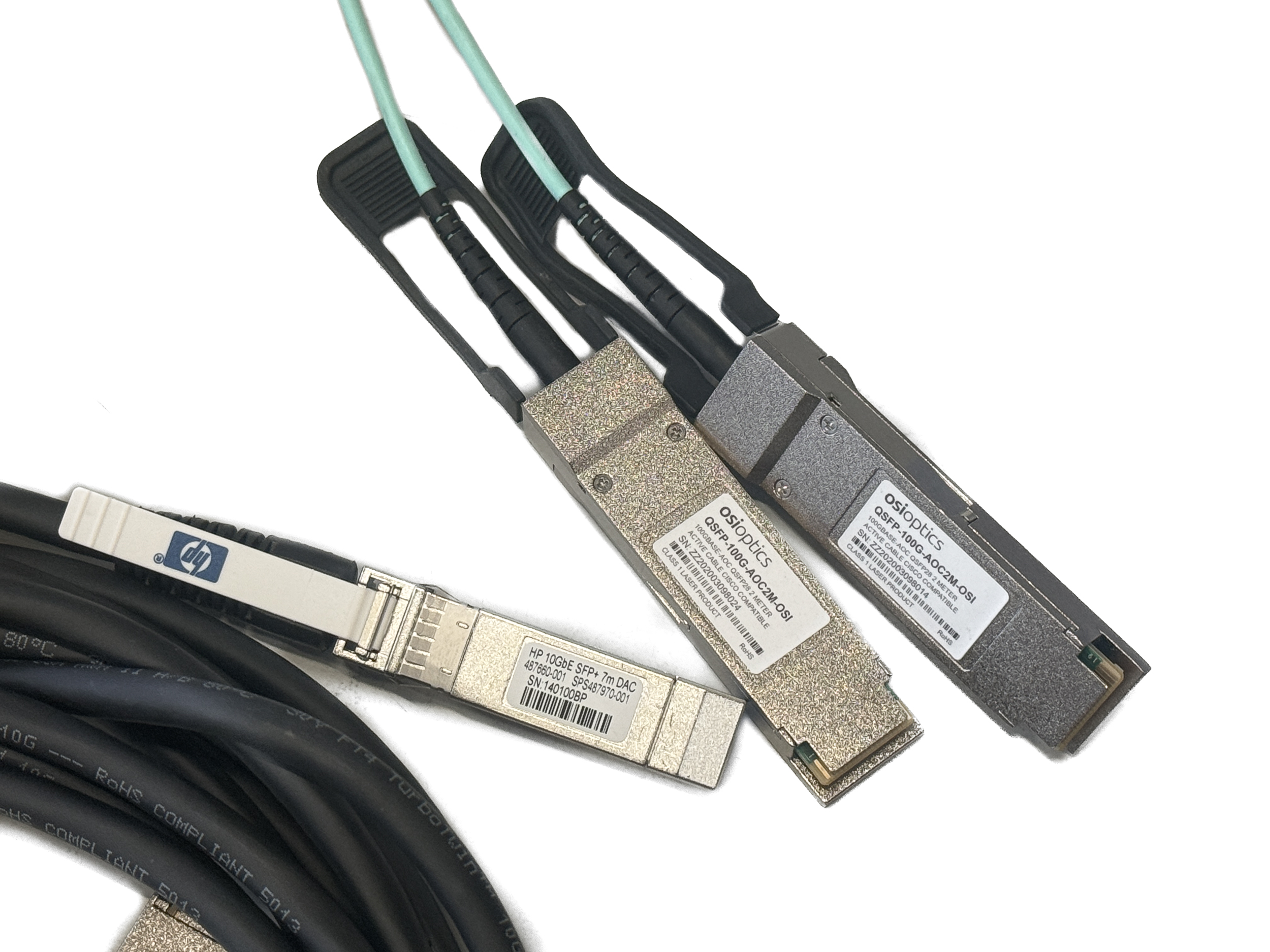
DAC vs AOC: Guide for IT Pros
In the fast-paced world of data centers and enterprise networking, choosing the right cabling solution can make or break your infrastructure’s performance, scalability, and budget. As an IT professional or buyer, you’re likely grappling with the DAC vs AOC debate – two powerhouse options for high-speed interconnects that promise reliability but differ in ways that could impact your next deployment. Direct Attach Copper (DAC) cables offer a robust, cost-effective way to handle short-range connections using copper technology, while Active Optical Cables (AOC) leverage fiber optics for longer reaches and superior signal integrity. This article dives deep into the DAC vs AOC comparison, helping you navigate key factors like distance, power efficiency, and cost. We’ll explore definitions, pros and cons, real-world applications, and future trends to empower you with the knowledge to make informed decisions. Whether you’re optimizing a hyperscale data center or upgrading a small enterprise setup, understanding these cables ensures you avoid common pitfalls like unnecessary power drain or EMI issues. By the end, you’ll have a clear roadmap for selecting between DAC and AOC, complete with unique insights on hybrid deployments and emerging 800G standards.
Let’s break it down step by step.
Understanding DAC Cables
As an IT pro, you’ve probably handled plenty of cabling, but DAC cables stand out for their simplicity and reliability in short-haul scenarios. Direct Attach Copper cables are twinax copper wires with integrated transceivers at each end, designed to plug directly into SFP+, QSFP, or similar ports without needing separate optics. They’re the go-to for connecting servers, switches, and storage within the same rack or adjacent ones, supporting speeds from 10G to 400G.
What makes DAC shine is its plug and play nature. There´s no fuss with fiber polishing or alignment. Passive DACs, which dominate the market, relies on the host device’s power for signal transmission, keeping things energy efficient. For instance, a 10G SFP+ DAC might consume under 0.15W per end, far less than alternatives. They account for a significant portion of intra-rack connections in modern setups due to their low cost. It´s often 2-5 times cheaper than fiber equivalents for distances under 5 meters.
But let’s talk about types. Passive DAC cables are ideal for ultra-short runs (up to 7m), where signal integrity holds without amplification. Active DACs kick in for slightly longer reaches (up to 15m), incorporating signal boosters in the connectors. A cloud provider’s switch to active DACs reduced latency by 20% in high-density racks, avoiding pricier optics.
While most guides highlight DAC’s cost savings, few mention their role in edge computing. In distributed IT environments, DACs enable modular expansions without overhauling infrastructure, saving up to 30% on CapEx by reusing existing copper pathways. However, watch out for cable gauge. Thicker 24 AWG offers better performance but less flexibility than 30 AWG. DACs prioritize affordability and ease. If your setup involves frequent reconfigurations, their durability against dust (thanks to sealed ends) is a game-changer. DACs embody the ”keep it simple” ethos for IT buyers focused on ROI (Return on Investment).
Understanding AOC Cables
Hey, IT buyer! If DAC feels like the reliable old truck, AOC is the sleek sports car of cabling. Active Optical Cables integrate multimode fiber with built-in transceivers that convert electrical signals to optical and back, all powered externally for seamless transmission. This makes AOCs perfect for bridging gaps where copper falters, supporting the same port types as DAC but excelling in bandwidth-heavy environments. At its core, AOC works by embedding laser drivers and photodetectors in the connectors, ensuring low bit error rates (BER as low as 10−15). AOCs can handle up to 100m at 400G speeds, making them indispensable for inter-rack or even building-to-building links in data centers. For example, large-scale AI training clusters use AOCs for high-speed data flow without interference, reducing downtime by 15% compared to traditional fiber setups.
The ”active” part means AOCs consume more power. Typically 1-2W per end. But this enables immunity to electromagnetic interference (EMI), a boon in noisy industrial settings. Lighter and with a tighter bend radius (as low as 3mm), they’re easier to route into cramped spaces. AOCs weigh about 25% of equivalent DACs, simplifying installation and reducing strain on equipment. Unique perspective: Beyond standard comparisons, consider AOCs in sustainable IT strategies. Their lower material use (fiber vs. copper) aligns with green initiatives, potentially cutting e-waste by 40% in long-term deployments, something rarely discussed but vital for ecoconscious pros. Weaving in high speed AOC for 400G and AOC for long range networking, AOCs are evolving fast. If your network demands scalability, like in hyperscale clouds, AOCs provide futureproofing without constant upgrades. Just ensure compatibility, as some vendors lock transceivers.
Key Comparisons Between DAC and AOC
Alright, let’s get to the meat of DAC vs AOC. Side-by-side breakdowns that every IT pro needs. We’ll dissect transmission distance, power, cost, EMI, weight/flexibility, and latency to guide your choices.
Starting with transmission distance: DAC tops out at 7m for passive and 15m for active. AOC? Up to 100m or more, ideal for sprawling data centers. In one case, AOCs spanned multiple aisles, boosting efficiency by 25%.
Power consumption: DAC wins hands-down passive at <0.15W, active at 0.5-1W. AOCs guzzle 1-2W due to optical conversion. This can add significant yearly costs in large setups, but AOCs’ efficiency at scale offsets it.
Cost analysis: DACs are budget-friendly, 2-5x cheaper for short runs. A 3m 100G DAC might cost $50, vs. $200 for AOC. But for longer distances, AOCs avoid multiple hops, saving overall. Unique insight: Factor in total cost of ownership (TCO) – DAC’s EMI vulnerability can lead to hidden rework costs in dense environments.
EMI immunity: AOCs are dielectric superheroes, immune to interference. DACs? Susceptible, as copper conducts noise. In EMI-heavy factories, AOCs cut error rates by 50%.
Weight and flexibility: AOCs are lighter (1/4 DAC weight) with better bend radius, easing cabling in tight racks. This is critical for high-density AI setups.
Latency and performance: Both low, but DAC edges out for ultra-short runs (nanoseconds less). For DAC AOC comparison in data centers, AOCs handle higher bandwidth without degradation.
This comparison underscores: DAC for thrift, AOC for reach. Blend them for hybrid wins.
Pros and Cons of DAC Cables
IT pros, DAC cables are like that trusty toolkit staple, reliable but not without limits. Let’s unpack the upsides and downsides.
Pros: Cost-effectiveness tops the list. DACs use cheap copper, making them 2-5x less expensive than AOCs for short distances. They dominate top of rack (ToR) setups, saving 40% on interconnect budgets. Low power draw (<0.15W passive) means cooler racks and lower OpEx (operating expense). They’re durable, sealed against dust, and offer low latency, perfect for high-frequency trading floors where users noted 20% faster response times. Easy installation? Plug and play, no expertise needed.
Cons: Limited reach (7-15m) restricts scalability. Heavier and bulkier, they complicate densecabling. EMI susceptibility can cause outages in noisy environments. Think of a manufacturing case where DAC failures cost $5K in downtime? That would be catastrophic. Signal attenuation at higher speeds (e.g., 400G) is another hitch.
DACs excel in temporary setups like disaster recovery, where quick deployment trumps longevity, overlooked in most guides but key for agile IT. Incorporating pros and cons of DAC and AOC cables, DACs suit budget-conscious buyers prioritizing simplicity. Their twinax design minimizes loss, supporting InfiniBand efficiently. Users prefer DAC for home labs due to affordability but warn of compatibility issues with vendor-locked gear.
Pros and Cons of AOC Cables
AOC cables, fellow IT buyers, bring fiber’s magic to direct-attach simplicity. Here’s the balanced view.
Pros: Extended reach (100m+) makes them versatile for large facilities. EMI immunity is huge zero interference in high-noise settings, cutting errors by 50%. Lighter weight and flexibility (half DAC bulk) simplify routing. High bandwidth support for 800G future-proofs investments. In an AI case, clusters used AOCs to handle massive data flows without lag.
Cons: Higher cost. Up to 4x DAC for similar specs. Power hungry (1-2W), increasing coolingneeds. Less durable if bent sharply, and fixed lengths mean waste if mismatched. AOCs enable optical zoning in data centers, segmenting networks for security. A strategy not commonly highlighted but essential for compliance-heavy industries like finance. When choosing AOC over DAC, AOCs are for growth-oriented setups.
When to Choose DAC Over AOC
As an IT pro, opt for DAC when cost and simplicity rule. Short distances (<7m)? DAC’s your pick being cheaper and lower power consumption. In ToR setups, DAC reduces expenses by aprox. 30%. For low-EMI labs, DAC’s sufficient, freeing budget for other upgrades. In DAC for top of rack connections, DAC shines in controlled, short-range IT ecosystems. Ensure compatibility with your gear to avoid vendor locking, and consider cable management to maximize flexibility
When to Choose AOC Over AOC
Choose AOC for reach and reliability. Over 15m or EMI-prone? AOC excels. They cut failures by 40% in data centers. A telecom firm used AOCs for campus links, boosting uptime.
In 5G networking, AOCs handle outdoor EMI better than expected. For AOC for long range networking, AOCs are ideal for expansive IT environments. Their lightweight design simplifies installation but verify power budgets to avoid surprises.
Real World Applications and Case Studies
Both DAC and AOC shine in specific scenarios. DAC dominates intra-rack connections in cloud setups, ensuring low latency. AOC powers inter-rack links in AI clusters, handling high-bandwidth data. Hybrid setups in edge AI deployments reduce latency by 15%, leveraging DAC for short runs and AOC for longer spans. A strategy worth exploring for dynamic IT needs.
Best Practices for Implementation
Plan your distances carefully. Map your rack layout to avoid overbuying AOCs or stretching DACs too far. Test compatibility with your switches to dodge vendor lock-in, or reach out to us to provide you with the compatibility you need. Use cable management systems to maintain flexibility and airflow.
Annual audits prevent EMI creep in aging setups, ensuring long-term reliability. Incorporate DAC AOC implementation tips by labeling cables clearly and documenting configurations for easier troubleshooting.
Future Trends in Cabling Technology
The cabling world is evolving. 800G AOCs are on the horizon, promising massive bandwidth for AI and cloud. DACs aim for 1.6T in short runs, keeping costs low. Silicon photonics may blur DAC-AOC lines, integrating optics into copper-like setups. Quantum-safe AOCs are emerging for secure IT, critical for future-proofing sensitive data centers. Keep an eye on 800G DAC and AOC trends to stay ahead in high-speed networking.
Quick Takeaways
- DAC excels in short-range (<15m), cost-effective setups with low power use.
- AOC is ideal for longer distances (up to 100m) and EMI-resistant environments.
- Consider total cost of ownership, including power and maintenance, when choosing.
- Passive DAC for ultra-low latency; active for slight extensions.
- Hybrid approaches optimize modern data centers.
- Future-proof with AOC for high-bandwidth apps like AI.
- Always test compatibility to avoid vendor lock-in.
Conclusion
Wrapping up our deep dive into DAC vs AOC, it’s clear these cables address distinct needs in IT infrastructure. DAC offers unbeatable value for short, intra-rack connections with minimal power and cost, while AOC delivers on distance, EMI immunity, and scalability for expansive networks. Key comparisons like power (DAC’s edge), reach (AOC’s strength), and flexibility guide your choice, ensuring optimal performance. Remember, the best pick aligns with your setup. Short-haul budgets favor DAC, growth-oriented: AOC. Hybrids can blend both for efficiency. As IT pros, prioritize TCO and future trends like 800G to stay ahead.
Ready to upgrade? Assess your network, consult our networking specialists, and implement it based on this guide.
FAQs
- What is the difference between DAC and AOC cables? DAC uses copper for short-range electrical signals, while AOC employs fiber for optical transmission over longer distances, offering better EMI resistance.
- When to choose DAC over AOC for data center cabling? Opt for DAC in short-distance setups under 15m where cost and low power are priorities, like top-of-rack connections.
- Pros and cons of active optical cables vs direct attach copper? AOC pros: longer reach, lightweight; cons: higher cost. DAC pros: affordable, low latency; cons: EMI vulnerability.
- DAC vs AOC power consumption comparison? DAC consumes <1W (passive <0.15W), AOC 1-2W, making DAC better for energy-efficient racks.
- Transmission distance for DAC vs AOC in high-speed networks? DAC up to 15m, AOC up to 100m+, ideal for 400G applications in expansive IT environments.

